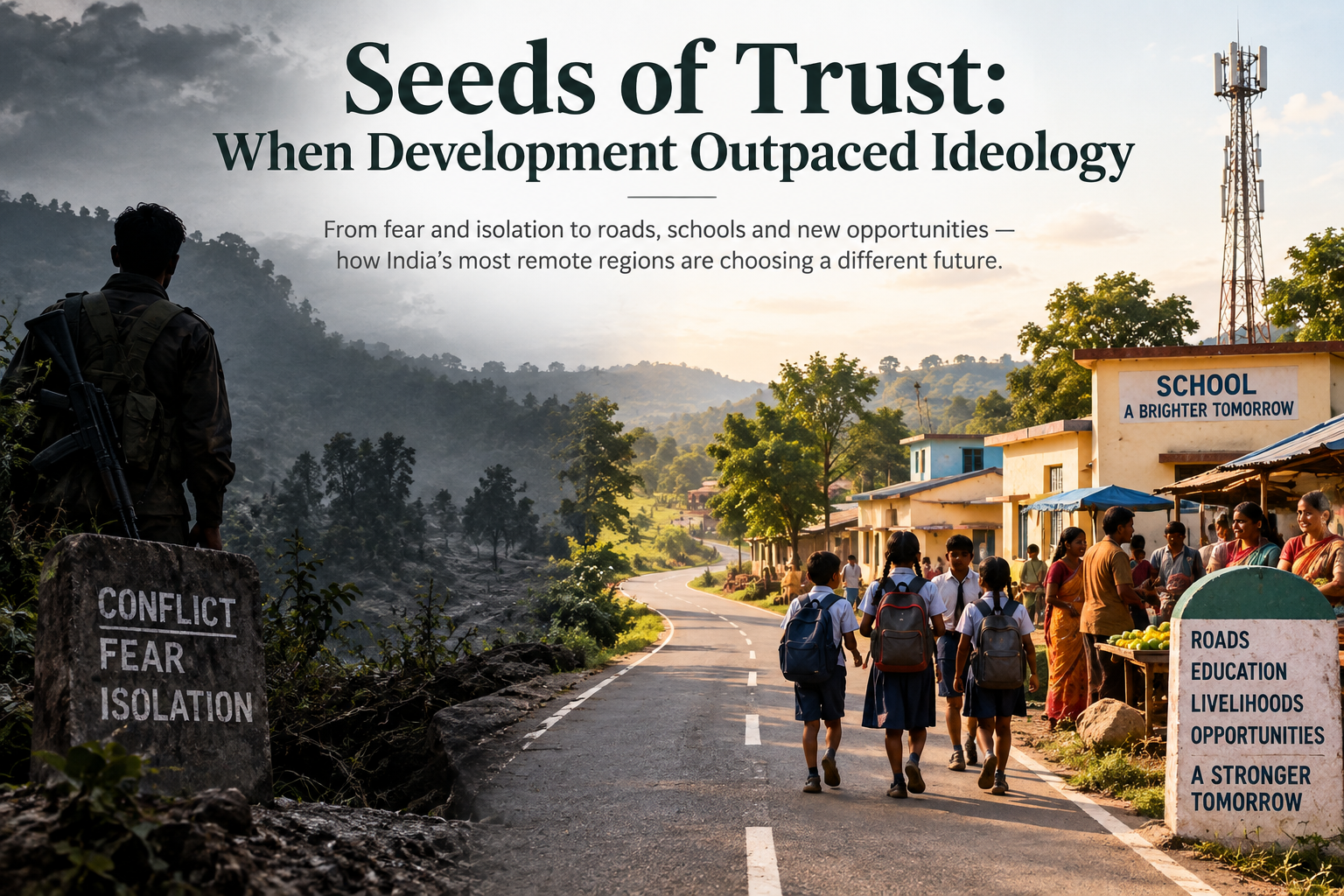
For decades, the dense forests of central and eastern India were defined by a singular, grim rhythm: the echo of gunfire and a heavy shroud of fear. Entire districts were categorized not by their rich cultural heritage or untapped potential, but by the clinical, bureaucratic label of being “Naxal-affected.” In these zones, progress was often the first casualty of conflict.
Roads would abruptly end in the dirt, schools stood derelict and empty, and the basic promise of governance felt like little more than a distant, unattainable rumour. However, a profound transformation is currently taking place across the heartland. This is not merely a story of successful security operations, but a deeper narrative of a social awakening; the story of how the people themselves decided to turn the page on a violent past.
For a long time, the Naxalite movement relied on a narrative of systemic neglect to justify its armed struggle, but over the last decade, that narrative has collided with a new, tangible reality. The vacuum once filled by extremist ideology is increasingly being occupied by the arrival of the state in ways that matter most to daily life.
This change did not happen overnight, nor was it a result of force alone; rather, it emerged from a fundamental comparison made by the people living on the front lines. On one side was an ideology that spoke of revolution but often delivered only destruction and stagnation. On the other was the slow but steady arrival of all-weather roads connecting remote hamlets to market towns, mobile networks bridging the communication gap, and direct benefit transfers ensuring that government aid reached the intended doorstep without leakages.
The true turning point occurred when the local population began to prioritize inclusion over isolation. As youth in states like Chhattisgarh, Odisha, and Jharkhand started seeing genuine opportunities in livelihoods and education rather than the barrel of a gun, the ideological foundation of the insurgency began to crumble from within.
Women’s self-help groups have played a particularly pivotal role in this transition. By becoming active stakeholders in the local economy, these women have woven a new social fabric that values stability and communal growth over disruption. The shift is visible in the small things: village markets that once shut down in fear at sunset now stay open late into the evening, signalling a fading of the terror that once dictated the movements of every citizen.
While the challenge has not vanished entirely, the path forward is clearer today than ever before. The “Naxal Mukt Bharat” vision is moving from a high-level policy goal to a lived reality for millions.
This transition proves that while security forces provide the necessary shield, it is development and democratic participation that provide the ultimate cure for deep-seated unrest. The story of the region is no longer one of “us versus them.” Instead, it is becoming a story of a nation integrating its most remote corners into a shared dream of prosperity.
The guns have gone silent because the voices of the people are demanding schools, hospitals, and a dignified future, which has finally become too loud to ignore.